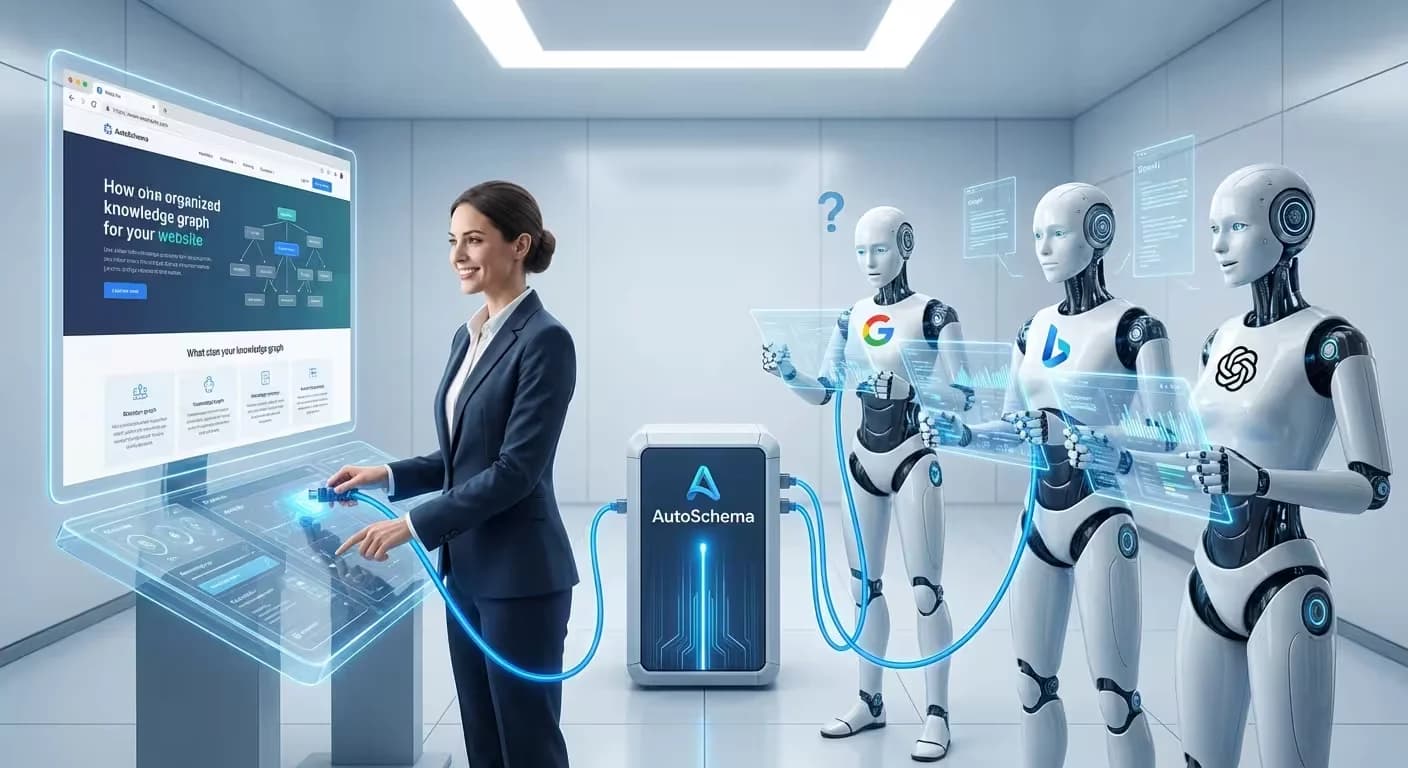
The new front door is a conversation
Something fundamental has changed in how people find businesses. Instead of typing keywords into Google and scanning a list of links, a growing number of people simply ask an AI: "What's the best accounting firm for a small e-commerce business?" or "Find me a web designer who specializes in restaurants."
ChatGPT, Perplexity, Google's AI Overviews, Siri with Apple Intelligence, Microsoft Copilot — they all work the same way. The user asks a question. The AI constructs an answer. It names two or three businesses. The user picks one.
There is no page two. There is no scrolling. There is no "let me compare a few more options." The AI recommends, the user acts.
If your business is not in that answer, you do not exist.
How AI decides who to recommend
AI assistants do not pick favorites randomly. They follow a hierarchy of trust, and it comes down to one thing: how clearly the AI can understand what a business is and what it does.
When an AI encounters a site with structured data — a JSON-LD knowledge graph that explicitly declares the organization type, services, location, ratings, and credentials — it treats that information as high-confidence facts. It can parse them instantly, compare them to other entities, and use them to construct a recommendation.
When an AI encounters a site without structured data, it has to guess. It reads paragraphs of marketing copy and tries to infer what the business does. Sometimes it gets it right. Usually it picks the competitor whose site was easier to understand.
This is not a ranking algorithm. It is a comprehension gap. The AI literally understands one business better than another — and recommends the one it understands.
A simple experiment you can run right now
Open ChatGPT, Perplexity, or any AI assistant. Ask it to recommend a business in your industry, in your city. Look at which businesses come up.
Now look at those businesses' websites. Check their source code for JSON-LD structured data. In almost every case, the recommended businesses have richer, more connected schema markup than the ones that were ignored.
This is not a coincidence. It is the direct result of how these systems work. They can only recommend what they can understand. And structured data is how you make yourself understood.
Why traditional SEO does not help here
If you have spent years building backlinks, optimizing page speed, and writing keyword-rich content, you have done valuable work — for Google's traditional ranking algorithm. But AI recommendation systems operate differently.
A backlink tells Google that other sites vouch for you. It does not tell ChatGPT what services you offer. Page speed tells Google your site is well-built. It does not tell Perplexity your business hours. A keyword-optimized blog post tells Google your page is relevant to a search query. It does not tell Siri that you are a certified, insured electrician who serves the Denver metro area.
AI recommendation needs entity-level clarity: structured, connected facts about what you are, not signals about how popular you are. This is a fundamentally different game, and most businesses are not playing it at all.
What structured data actually changes
When your site has a proper knowledge graph, every AI system that crawls it gets a clear, unambiguous picture: the name of your organization, its type, its location, the services it provides, its operating hours, its credentials, and how all of these entities relate to each other.
This is not about getting a Google rich snippet — though that happens too. It is about becoming a first-class entity in the databases that AI systems query when constructing answers. You move from "some text on a page" to "a known business with verified attributes."
That shift changes everything. AI assistants start including you in recommendations. Voice search returns your business name. Google's AI Overviews cite your services. You become part of the answer instead of being lost in the noise.
Making it happen without the headache
Building a proper knowledge graph by hand is real work. You need to understand schema.org types, JSON-LD syntax, @id cross-references, and Google's validation rules. Most developers do not specialize in this. Most SEO agencies charge hundreds per month to maintain it manually — and it breaks whenever someone updates the CMS.
AutoSchema eliminates that entire problem. One script tag added to your site. The engine scans your pages, identifies entities, classifies page types, and builds a connected knowledge graph automatically. It updates when your content changes. It validates against Google's requirements. It never fabricates data.
The result: every AI system that visits your site gets a clear, structured, trustworthy picture of your business. You do not need to learn schema.org. You do not need an SEO agency. You need one line of code.
Are AI assistants recommending you?
Scan your site and see what AI systems currently understand about your business. The gaps might surprise you.
Run a free scan →